A story about giving
For the Fixes Nobody Sees
Marcus had three weeks and zero ideas for his father's sixty-fifth birthday. Bernard fixed everything he touched and wanted nothing in return — and the gift that finally landed didn't give him a single new tool.
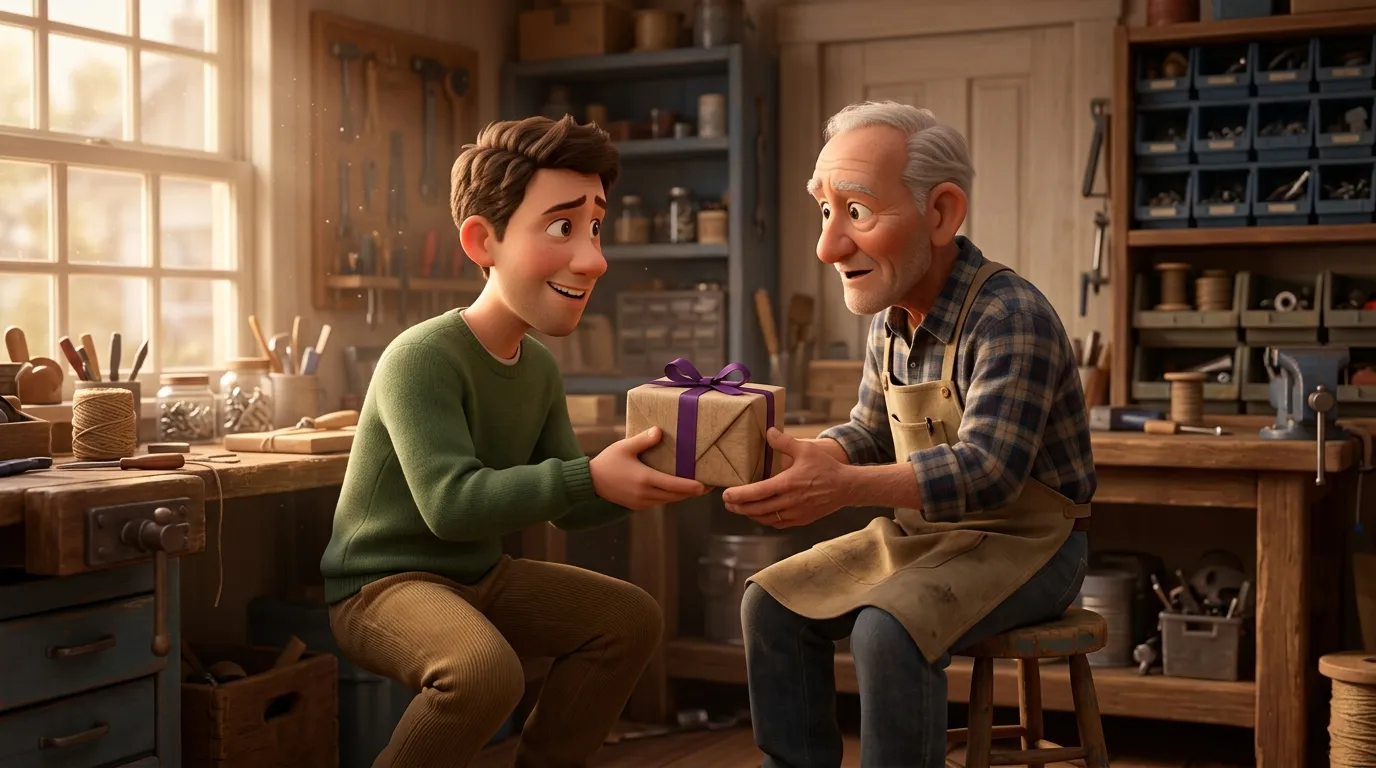
Setup
Marcus had grown up watching his father fix things and feeling distinctly unhelpful about it.
Bernard could rebuild an engine, rewire half a house, and diagnose a failing appliance by sound. Marcus had gone to school for marketing and eventually gotten good at building things in the abstract — campaigns, pitches, positioning statements — things you couldn't hold. It was a life he liked. But every time he tried to buy his father a gift, he felt it: the slight wrongness of a tourist trying to bring something back from a country he'd never quite entered.
He'd given scotch, because people gave Bernard scotch. He'd given tickets to something Bernard would have to travel for. He'd given a cordless drill from a brand Marcus had researched carefully and Bernard had quietly returned.
Bernard turned sixty-five in September. That number felt like it deserved something real. Marcus opened a browser tab. Then another. Then, at eleven at night, he closed both of them.
Bernard had once driven forty miles to fix a neighbor's washing machine because he'd overheard the phrase "it's making a noise" at a backyard barbecue. Fixed it, accepted a glass of water, drove home, never mentioned it again. He'd rewired two houses on his street over separate summers, after the neighbors mentioned their wiring was "probably fine." He kept the same stubby pencil in his chest pocket since 1999. He owned three dress shirts — a light blue, a white, and a green that had been that particular shade for thirty years and showed every intention of staying that way — worn in a rotation Marcus had been trying to decode since childhood without success.
Bernard's love was entirely in his hands. And every gift Marcus had ever given felt like it came from someone who didn't know that.
He wanted, for once, to give his father something that didn't feel that way. He just had no idea where to start.
Gift
He opened Forgift on a Wednesday night, mostly out of mild desperation.
The app didn't ask what Bernard liked. It asked what Bernard did when nothing needed fixing. Then what he would fix if he had the time and nobody was waiting. Then — and Marcus paused here — what Bernard was good at that had never been officially named.
Marcus typed for a while.
The fixing wasn't the thing, he wrote, or not exactly. It was the refusal. Bernard couldn't stand watching something get thrown away before its time. An appliance that still had a working compressor. A vehicle with two hundred thousand miles that just needed someone to care about it. Throwing things away when they could be fixed seemed wrong to Bernard the way lying seemed wrong to other people — not as a choice, but as a matter of fact.
The app came back with a reframe Marcus hadn't been reaching toward.
He's not a fixer. He's a preservationist. The gift isn't more tools — he has those. It's something that treats what he knows as worth keeping.
It surfaced: a set of mid-century repair manuals — the illustrated kind, from the fifties and sixties, where technical illustrators drew hand-rendered exploded diagrams of common household appliances. Coffee makers disassembled into numbered components. Washing machine cutaways showing the drum from three angles, every belt and spring labeled in clean mechanical print. Obsessive. Beautiful. Made entirely by hand by people who believed that how a thing worked was worth drawing.
And a plain leather notebook — no illustration, no subtitle — with a single line pressed inside the front cover: For the fixes nobody sees.
Marcus had been looking at Scotch sets and experience boxes. He'd been solving the wrong problem entirely. The app had named what Bernard had been doing since before Marcus was born and asked: what if someone treated it as something worth keeping a record of?
He ordered everything that night.
Moment
Bernard opened the box at the kitchen table on a Saturday morning, while Marcus's mother made a point of being near the coffee maker and not making any particular expression.
Bernard lifted out the first manual. Turned it over. Opened it to the middle — a full-page cutaway of a 1957 electric range, every burner element labeled in pencil by someone who had done this for a living and clearly enjoyed it.
He went quiet. With Bernard, quiet meant thinking.
"Hand-drawn," he said. Not a question.
"All of them," Marcus said.
Bernard turned a few pages. Found a diagram of a washing machine agitator showing the mechanism from five angles. Read the notation. Set the manual down carefully — which was not a thing Bernard did with things he wasn't going to keep.
He didn't say thank you. He didn't get up. He picked it back up and kept reading.
Marcus drank his coffee. Didn't add anything.
That was it. That was the moment. You either know what it meant or you don't.
Ripple Effect
Two weeks later, Marcus got a text at 7:14 in the morning.
It was a photo. Bernard had fixed a vintage toaster — not his, a neighbor's, an old one found in a box — and had made a diagram of it in the notebook. In pencil. Thirteen parts. His own block letters. A note at the bottom: bimetallic strip — replace first, always the problem.
The style was different from the manuals. Looser. A first attempt. But it was labeled, and dated.
Marcus showed it to his wife, who laughed in the way people laugh when something is unexpectedly moving. He texted it to his cousin. He showed it to his barber, which was genuinely hard to explain in the moment.
The notebook had five more entries after that. Not many — Bernard was not a writer and would not under any circumstances become one — but five repairs documented with pencil diagrams and short annotations. A ceiling fan motor. A vintage hand mixer that had apparently been in someone's attic since 1981. A lawnmower carburetor with a small star drawn next to it and no further explanation. He had never, in Marcus's entire life, drawn a star on anything.
At some point between Bernard's birthday and Thanksgiving, the jar of mismatched buttons that had lived on his workbench since approximately 1989 disappeared. In its place: a small box, buttons sorted by size in labeled bags. Whether this was related to the notebook was a question Marcus chose not to investigate.
The manuals lived on Bernard's basement workbench — the good one, the one Bernard had built himself in 1991 and spent thirty years not cluttering. Open to a different page than the time before.
Marcus visited in November. He didn't mention the manuals. Bernard didn't mention them. The green dress shirt was there too, same as always.
Some things stay exactly what they are.