A story about giving
He Remembered She Used to Draw. He Didn't Know She Still Did.
David hadn't seen his daughter draw in three years and assumed she'd moved on. The app asked one question he hadn't — and what it found wasn't a hobby she'd quit. It was permission she'd been waiting for.
Setup
David Kirsch has a recurring calendar event called "Emma's Birthday" that his assistant set up in 2012. He has never edited it. He has never had to.
He is the kind of man who signs his texts with his full name. Confirmed for Tuesday. — David. Running five minutes late, apologies. — David. Emma has twenty-three of them saved. She finds them so specifically insane that she showed her friends once, and they still bring it up.
He works in finance. Travels constantly — Toronto, New York, London, back to Toronto on a red-eye to make a 7am school thing, which is the kind of math he is quietly proud of. He loves Emma the way you love someone when your love is enormous and your schedule is not: out loud, occasionally, at airports.
She was turning fifteen.
He knew things about Emma the way you know a city you used to live in. You remember the landmarks. You'd recognize the street. The new parts — the ones that grew while you were elsewhere — you'd get lost in those. She was quiet. Good grades. Small friend group. Spent a lot of time in her room watching things on her laptop. She didn't ask for much, which either meant she was easy-going or she'd stopped expecting things to come through. David chose the former.
Emma used to draw. He remembered that clearly. Horses, mostly. She'd line the fridge with them — the door was covered at one point, this whole gallery of animals in Prismacolor pencils, each one better than the last. He'd say "beautiful, Em" every time he walked by, then leave for somewhere. Somewhere around seventh grade, the drawings stopped. He figured it was like soccer, like the other things kids pick up and put down when they get older. Kids move on. He moved on with them, or thought he had.
His home office has a print of a Monet water lily painting that came with the frame when he bought the frame in 2017. He has never looked at it directly.
Her birthday was ten days out.
Gift
He opened Forgift & Forget on a Tuesday night at his kitchen table, which was unusual because David did not usually sit at his kitchen table.
He filled in Emma's profile the way he answered emails: efficiently, in order, moving fast. Name. Age. Relationship. Interests. He typed "art (used to draw, stopped)" and moved on.
The app didn't move on.
When she was drawing — what happened to the drawings? Where did they go?
He thought about the fridge. He thought about a Post-it note she'd given him when she was nine — a horse, loose and confident, shaded with the kind of certainty you can only have before you start comparing yourself to anything — that he'd slipped into his wallet and never taken out. It was still there, softened to the texture of old paper.
Has she stopped making things, or has she moved to watching people make things?
He stopped. He'd seen the laptop screen. YouTube thumbnails of colored pencil tutorials, hands drawing, time-lapses of finished work. He'd assumed it was background noise. It wasn't background noise.
The app came back with a thesis. Not suggestions — a thesis. Something like this: Emma hadn't stopped loving art. She'd stopped believing she was allowed to take it seriously. There's a move kids make around thirteen, the app laid it out plainly, where they quietly demote the things they love most — treat them like relics from an earlier self — because nobody has told them it's okay to keep going. They decide on their own that it isn't. A beginner's kit sends the wrong message entirely. A beginner's kit says you're just starting out. What she needs is someone to say: you're already in it. Here are the tools that say so.
Professional-grade colored pencils. A large sketchbook — real paper weight, wire-bound, the kind working artists use. A small wooden box, engraved: Emma's Studio.
Not a gift. A verdict.
David sat with that for a moment. The argument was so clear he was briefly annoyed he hadn't arrived at it himself. She'd been watching tutorials for two years. She hadn't stopped wanting to draw. She'd just stopped thinking she was allowed to justify the supplies.
He hadn't thought of it that way. The app had.
He ordered everything that night.
Moment
The birthday was on a Sunday. Emma came downstairs at eleven in a sweatshirt that had been washed so many times it no longer fully remembered what color it was. She found the wrapped box on the kitchen table and started pulling the paper off with the focused disinterest of someone who had learned not to hope too hard for things.
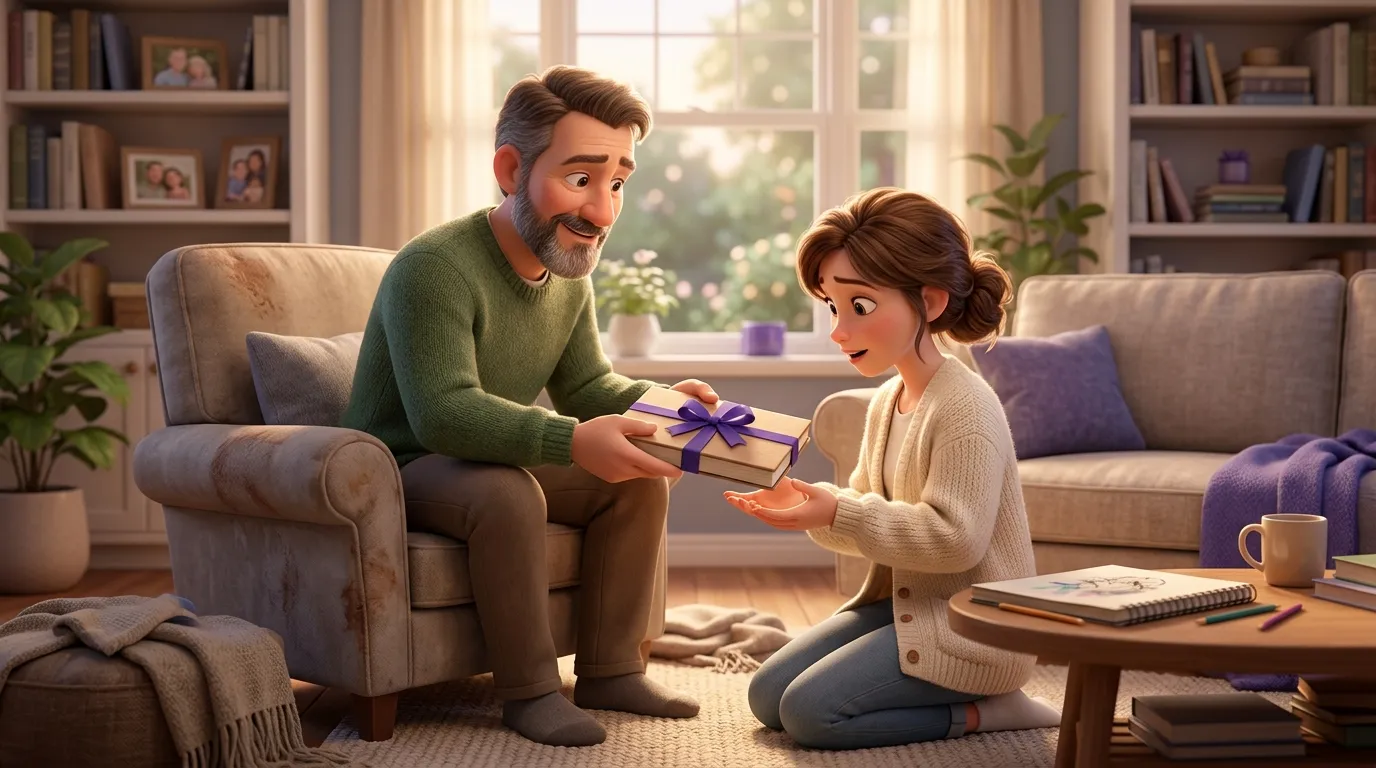
She opened the wooden box first.
Emma's Studio.
She went quiet. The real kind of quiet, not the teenager kind.
"You remembered I used to draw?" she said, looking up at David, who was standing near the coffee maker doing a convincing impression of someone reading his phone.
"You didn't stop being good at it," he said. "You just stopped doing it."
She pulled out the pencil set and fanned it open. There are 120 pencils in a professional set — every shade in a spectrum that keeps going, arranged in a row like a sentence that hasn't ended yet. She looked at them for a moment. Closed them carefully. Picked up the sketchbook. Felt the paper. Set it down.
"Okay," she said.
For Emma, that was a lot.
She didn't draw that day. She organized the pencil set by color family, spread across the kitchen table, with the quiet focus of someone who had been waiting for a reason to do exactly this. It took forty-five minutes. David watched for about three of them from the hallway, then left her to it.
Two days later, he walked past her room. The door was open. The sketchbook was open.
He kept walking.
Ripple Effect
Three months later, a text came through on a Tuesday afternoon.
It was a photo. A horse — colored pencil, soft grays and warm browns, the body turned three-quarters toward you so you could see where the light caught the shoulder. Not a kid's drawing. Not a sketch. A drawing.
David stared at it. He was in the back of a car in New York, twenty minutes from a dinner he'd been looking forward to. He read the caption — just finished it — and sat with the photo longer than made sense, long enough that the driver checked the mirror.
He typed back: This is outstanding work. I'm genuinely proud of you. — David.
She screenshot it. Sent it to her friend group without explanation. "my dad" she captioned it, three laughing emojis. The signed text. He had no idea.
A week after that, another text: Can I put the horse in your office? I feel like it belongs somewhere better than my wall.
David looked at the Monet water lily print that had been in his office since 2017 — the one that came with the frame, the one he had never once looked at directly. He took it off the wall. Stood there for a moment holding a water-lily painting with absolutely no idea what to do with it.
The horse went up the next day.